[001][31.03.26]

From region-specific ‘keys’ to clandestine retailer signatures, our Italian contributor reveals the (not so) hidden meaning behind the various small markings you’ll find on Swiss-made vintage timepieces.
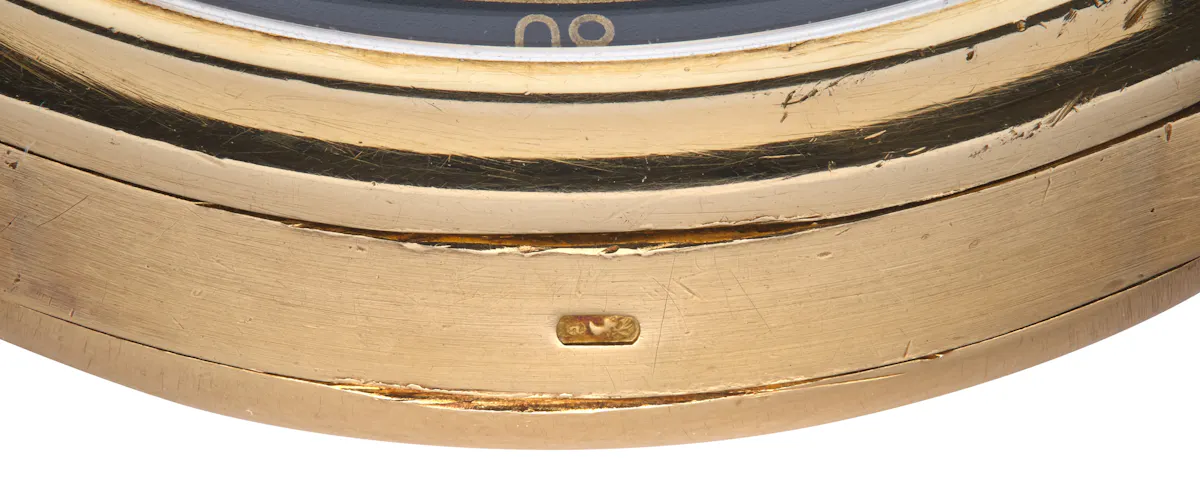
Collectors and enthusiasts know it: when evaluating a watch, it’s the details – more than anything else – that count. Sure, a trained eye can assess overall condition and quality at first glance, and maybe even go so far as to reveal whether a dial has been cleaned, refinished or redone. But there’s a lot more behind that - something that is often discreetly concealed where you’d least expect it: below the lugs, inside the caseback, even on the movement bridges. We’re talking hallmarks, and today we’ll dive into the fascinating and complex world of case stamps, their origins and the hidden meaning they carry.
Hallmarks have long been used in jewellery to assess the title of alloys, the exact provenance of a specific artifact, or even register payment of fees and duties to which precious metals are often subject. It should come as no surprise then that Switzerland – a nation known both for its prolific production of watches and its precise bureaucracy – established a conventional system to mark the cases produced in the country as early as 1880.

The face of Helvetia, Switzerland personified, was used to mark 18kt gold cases; a squirrel was the symbol adopted for 14kt alloys; and the head of a chamois (a mountain goat) identified platinum cases. These symbols are undoubtedly known to many collectors, as they are easily spotted on virtually any vintage watch. Look closely and you’ll find them underneath the lugs of Rolex watches, inside the caseback or along the caseband of Patek Philippe references, and so on.
But the Swiss took this marking system even further in 1926, when they introduced the so-called poinçons des maîtres (literally “artisans’ hallmarks”). Conceived to identify specific makers, these hallmarks were composed of two elements: an object, corresponding to a geographic area, and a number indicating the artisan. Casemakers based in the city of Geneva would be assigned a ‘Geneva Key’.
Notable manufacturers included: Wenger (1), Gerlach (4), or Baumgartner (8). Casemakers working in the rest of Switzerland, on the other hand, were instead identified by a hammer head; for example Favre Perret, based in La-Chaux-des-Fonds, was identified by hammer number 115.
As mentioned, the hallmark identifying the title of the alloy, as well as the poinçon de maitre, were only mandatory for precious metal cases. Nevertheless, some casemakers used to stamp stainless steel cases too, using different – but equally recognisable – markings.

One notable example is Taubert Frères, universally known as “FB” by the initials of its founder Francois Borgel, found in the brand’s hallmark above a key; another one is Charles Rodolphe Spillman, who manufactured almost all cases for hand-wound Daytonas, marking the gold ones with his own hammer (number 136), and the stainless steel ones with his initials C.R.S., usually found inside the caseback. In more modern times, a fitting example of this has been the late Jean-Pierre Hagmann, often regarded as the maker of the finest minute repeater cases, who stamped all his creations with the iconic “JHP” monogram.
It’s clear that makers’ marks do an effective job of showing where a watch comes from; however, that tells us just half of the story: what about where a watch goes after it is manufactured? Fear not: there are hallmarks to keep track of that, too. Often referred to as “import marks”, they are small figures stamped on watch cases by custom officers of specific countries who used to apply import taxes on valuable items.

The French mark, for example, consisted in an owl which can be found – for example – on the case of Cartier watches manufactured in Switzerland, and sold through the Paris branch of the company. Similarly, Portuguese authorities stamped watches with different marks, varying according to the case material (precious metal, plated metal or ‘poor metal’ – a peculiar designation for stainless steel). The type of metal defined the image on the mark, and the outline of the mark itself corresponded to a specific custom office. It must be noted that these marks – called ‘Salazar Stamps’ as a nod to the Portuguese dictator who introduced their use – are usually so tiny they could look like damage to the case at first glance, and for this reason are generally found on the side of ‘poor metal’ watches, but only on the caseback of solid gold ones.
A different type of import mark is found on the movements of watches sold in the US: every major Swiss company distributing its timekeepers through an American agency would indeed use three letters to designate the units destined for the North American market. These letters would be ‘HOX’ for Patek Philippe/Henri Stern Watch Agency, ‘ROW’ for Rolex, ‘VXN’ for Vacheron Constantin and ‘AYP’ for Audemars Piguet – among others.

Another kind of hallmark, finally, is the so-called ‘retailer’s mark’. As the name suggests, these were not applied by a third-party supplier, nor by an importer, but by the retailer of the watch. This could be done for stock-tracking purposes, as Cartier did: the New York branch applied an internal inventory number underneath one of the lugs, while the New Bond Street boutique marked the cases and clasps with the same serial numbers. Asprey, another notable London-based jeweller, used to inscribe its name in capital letters on the caseback of the watches customised on behalf of the Sultanate of Oman, possibly because the country’s national crest, the coveted Khanjar, didn’t leave any room for a signature on the dial.
Obviously, hallmarks play a crucial role in informing the value of a watch: an accurate inspection of case stamps should never be skipped, in order to make sure that they reflect what the dial or the papers say. Are you buying a Patek signed by a US retailer? Make sure there’s a HOX stamp on the movement. Do you want to make sure the Khanjar dial they’re offering you is genuine? Look for the Asprey inscription on the caseback.
As we’ve said, the smallest detail can make all the difference: so remember to do your due diligence, and never overlook hallmarks!